
Continues from Four years on: what held, what still needs work — if you haven’t read that yet, start there.
Our charter also rested on a few quiet assumptions — instructive at best, almost amusing at worst:
- Finding doctors whose outlook aligns with Trini’s would not be difficult.
- Good clinical staff would arrive already trained — technically and in soft skills — at least at a basic level.
- Patients would treat healthcare as specialised care, not as a commodity to be shopped like any other product.
We now see that many of these challenges cannot be solved once and locked away. They have to be managed — carefully, repeatedly — as we walk this path.
Before we go deeper into those challenges, one idea helps: the performance of people and systems usually gathers around a middle. Outliers are normal. Good management is about the whole distribution — not about chasing perfection. To see why, it helps to understand the normal curve.
The normal curve
Think of it almost as a quiet law of nature. Measure enough of nearly anything that varies — the heights of trees in a forest, the weights of newborns, daily temperatures over a season, or test scores in a large class — and a pattern appears again and again. Most values sit near the middle. Fewer sit farther out. Very few sit at the extremes. Plot those values and you get a curve that rises to a peak and falls away on both sides.
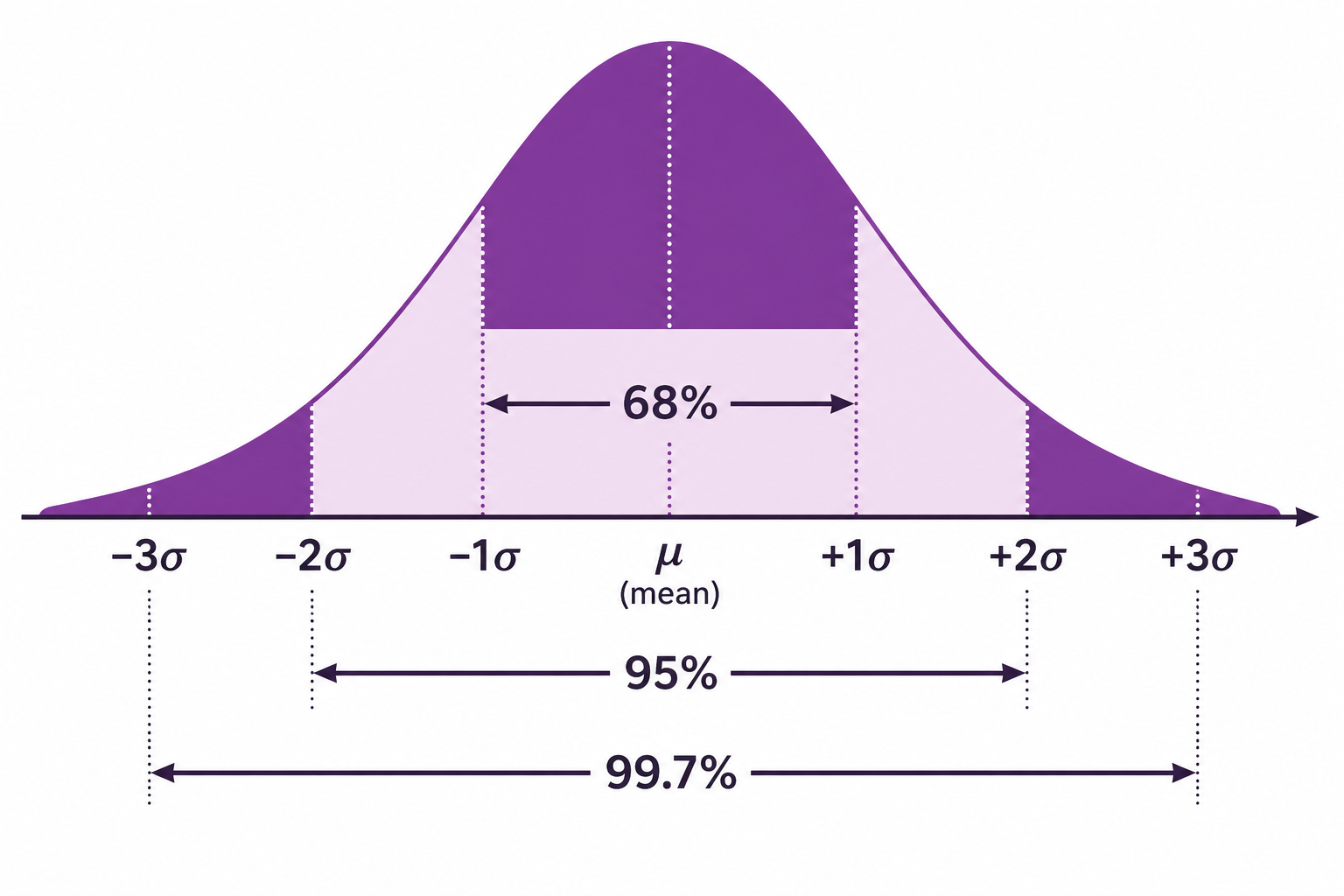
At the centre is the average (the mean). Spread is measured in standard deviations — how far values typically sit from that average. You do not need the formula to use the idea. What matters is the rough rule of thumb that keeps showing up in the real world:
- About 68% of values fall within one standard deviation of the average
- About 95% fall within two standard deviations
- About 99.7% fall within three standard deviations
In plain terms: most of life lives near the middle. The tails are thinner — but they are never empty.
That is why chasing “everyone, always, perfectly” is a trap. In a clinic, doctors, staff, patients, and systems will cluster around a typical level of performance. Some days and some people will be better than average. Some will be worse. Outliers are not a failure of the model. They are part of the model.
So when we say Trini’s challenges cannot be solved once and locked away, we mean this: we are not hunting for a world with no variation. We are learning to manage a distribution — to lift the middle, shorten the bad tail where we can, and stay calm when the rare extreme appears.
In the posts that follow, we will look at those challenges with this lens in hand — starting with the first assumption: finding doctors who share Trini’s outlook.
Previous: Four years on: what held, what still needs work
Next: What we know now: the long road into medicine — why the pool of aligned physicians is smaller than we assumed.
Have questions about this topic?
Talk to our doctors